

Why Your Heart Rate Variability During Sleep Matters More Than You Think
Heart Rate Variability (HRV) has become one of the most talked-about signals in health tracking
Heart rate variability, or HRV, might sound complicated, but the idea is actually simple. It looks at the tiny differences in time between each of your heartbeats. Your heart doesn’t beat at a perfectly steady rhythm. Instead, there is a natural variation from one beat to the next, and that variation tells a story about how your body is doing.
Think of it like this. When your body is relaxed and recovering well, your heart has more flexibility in its rhythm. When your body is stressed, tired, or run down, that rhythm becomes more rigid. So HRV is less about your heart itself and more about what’s going on behind the scenes, especially how well your body is handling stress and recovery.
That’s why HRV has become such a popular health metric. It gives you a glimpse into how your body is really feeling, even when you might not notice it yet.
But when you measure HRV matters just as much as what you measure.
During the day, your HRV is constantly being affected by everything you do. Moving around, drinking coffee, dealing with work, even just standing up or sitting down can change it. That makes daytime readings a bit noisy and harder to rely on.
Sleep is different.
When you’re asleep, your body is finally at rest. You’re not moving much, your breathing is steadier, and outside stress is lower. This creates the perfect environment to get a clean, consistent reading. In other words, your HRV during sleep gives a much clearer picture of how your body is actually recovering.
This is where HRV becomes really useful.
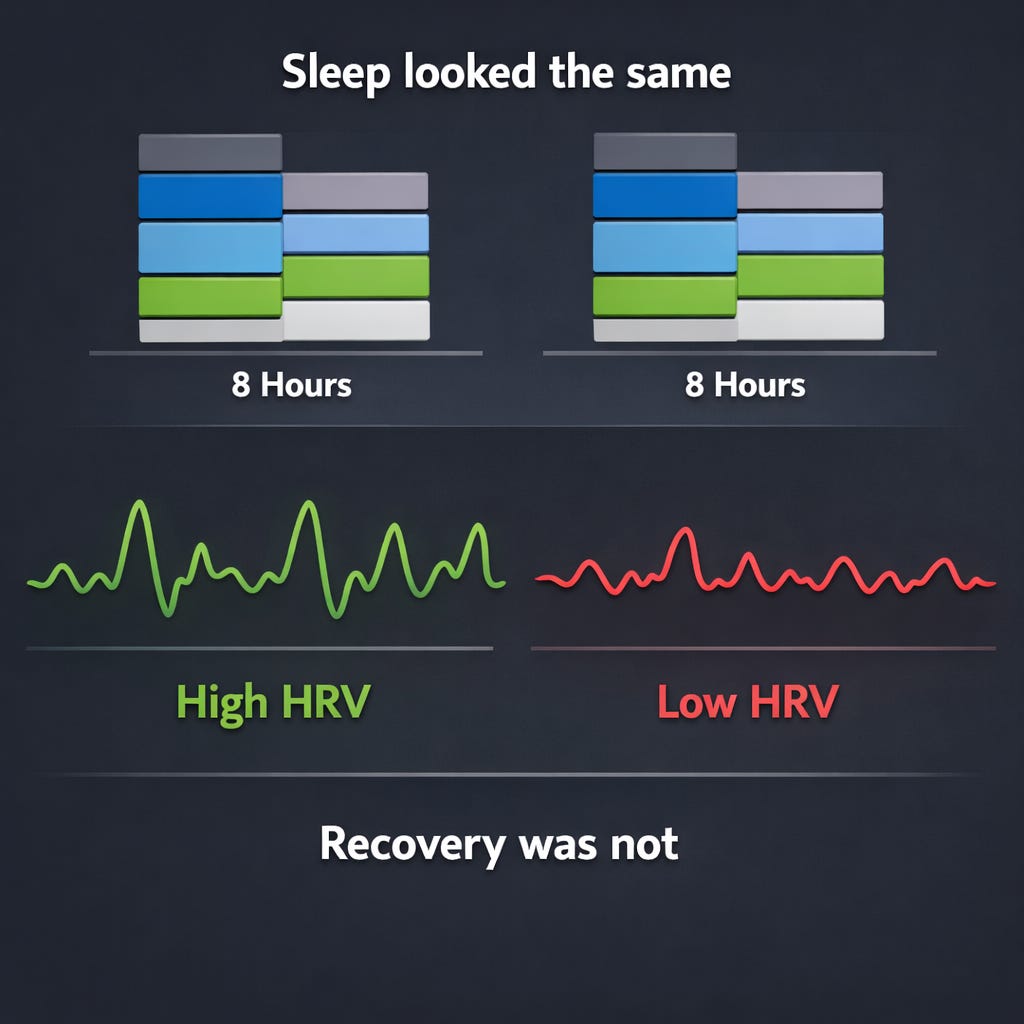
Two nights of sleep can look the same on the surface. You might get the same number of hours and even similar sleep stages. But your HRV can reveal a completely different story. Maybe one night your body recovered well, and the next it didn’t. Things like stress, alcohol, late meals, or getting sick can all show up in your HRV, even if your sleep “looked” fine.
When people talk about HRV in sleep trackers, they are usually referring to a specific type of measurement that focuses on short-term changes between heartbeats. This is the type that best reflects how active your body’s recovery system is. There are other ways to measure HRV, but they are more commonly used in medical settings and are less helpful for everyday sleep tracking.
The key takeaway is simple.
HRV during sleep helps answer an important question that other sleep metrics can’t fully explain. Not just “Did you sleep?” but “Did your body actually recover?”
Over time, watching your HRV trends can help you understand how your habits affect you. You may start to notice patterns, like how certain foods, stress levels, or routines impact your recovery. It gives you a way to connect how you feel with what your body is actually experiencing.
Sleep is when your body does its most important repair work. HRV is one of the clearest ways to see how well that work is happening.