

Understanding Hypoxic Burden
Moving beyond event counts to understand the true impact of oxygen drops during sleep.
Sleep data can be deceptively noisy. Numbers shift from night to night, and it’s easy to overinterpret a single spike or dip. That’s exactly why hypoxic burden matters. It reframes the conversation away from isolated events and toward the total physiological impact of oxygen disruption during sleep.
SomnoTrak is designed around that idea. Rather than simply flagging oxygen drops, it captures how much those drops actually affect your system, and more importantly, how that pattern evolves over time.
What Hypoxic Burden Really Measures
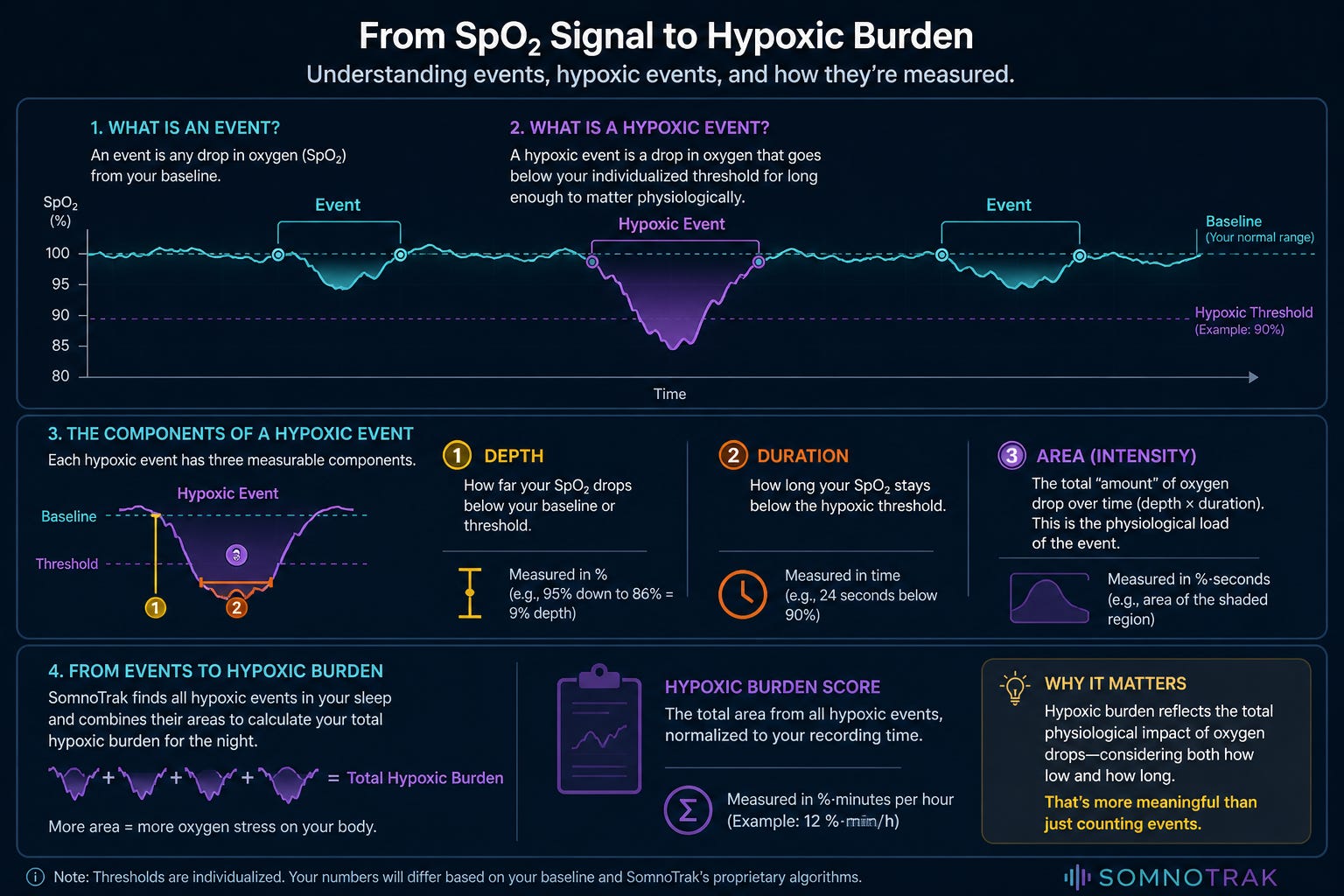
Traditional metrics like ODI focus on frequency. They count how many times oxygen drops during the night. That’s useful, but it leaves out two critical dimensions: how far oxygen drops and how long it stays there.
Hypoxic burden brings those elements together. It reflects the cumulative load of all oxygen desaturation events across the night.
A simple way to think about it:
Event count tells you how often something happened
Hypoxic burden tells you how much it mattered
Two nights can look identical from an event-count perspective while having very different physiological impact. Hypoxic burden captures that difference.
How SomnoTrak Measures It
Using continuous SpO2 data, SomnoTrak identifies meaningful desaturation events and evaluates each one in context. It measures:
The drop from your baseline (depth)
The time spent below that level (duration)
The combined effect of all events across the night
Those pieces are aggregated into a single nightly signal that reflects total burden.
But the real value isn’t the number itself. It’s how that number behaves over time.
Why This Metric Matters
Your body doesn’t respond to “event counts.” It responds to total oxygen disruption. That’s what hypoxic burden approximates.
Because of that, it becomes a more meaningful lens for understanding sleep quality. It highlights patterns that would otherwise be missed, especially when event frequency stays constant but severity changes.
This is where SomnoTrak’s approach stands apart. It doesn’t push rigid thresholds or alarms. Instead, it emphasizes relative change and personal baseline, keeping the focus on trends rather than isolated readings.
Interpreting Your Trend Over Time
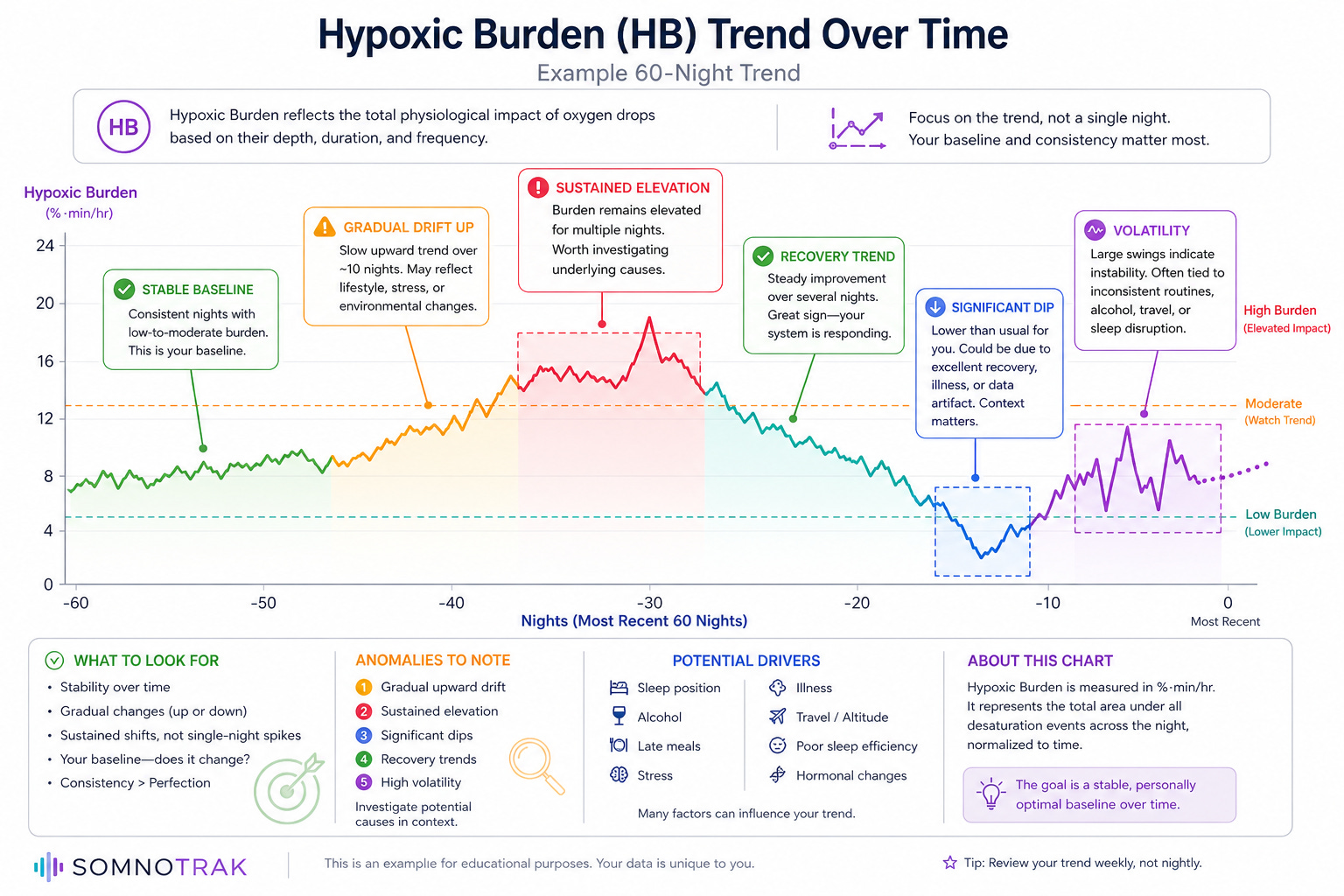
A single night rarely tells a useful story. What matters is how your hypoxic burden evolves across multiple nights.
When reviewing your data in SomnoTrak, pay attention to a few key patterns.
Stability is the goal
A flat, consistent trend indicates that your system is behaving predictably. That’s the ideal state, regardless of the absolute value.Gradual drift signals change
A slow upward or downward movement over several nights often reflects a shift in conditions, whether lifestyle, environment, or sleep behavior.Volatility points to inconsistency
Large swings between nights suggest instability. These are often tied to irregular routines or external factors.Sustained direction matters more than spikes
One high or low night is noise. A directional move that persists is signal.
Over time, you may also notice your baseline itself shifting. That’s one of the most valuable insights. It means your “normal” is changing, and that’s something worth paying attention to.
What to Avoid
It’s easy to misinterpret this kind of data, especially if you’re used to thinking in terms of “good” and “bad” numbers.
Avoid a few common pitfalls:
Don’t react to a single night
Don’t assume higher is always worse or lower is always better
Don’t compare your numbers to someone else’s
Hypoxic burden is inherently personal. The value comes from your trend relative to your own baseline, not from external benchmarks.
Why SomnoTrak Focuses on Trends
Many systems rely on thresholds and alerts. SomnoTrak intentionally avoids that model. It keeps the experience grounded in general wellness by focusing on patterns, consistency, and change over time.
Instead of telling you something is wrong, it shows you how your body is behaving. That subtle difference matters. It allows you to observe, adjust, and learn without overinterpretation.
The Bigger Picture
Hypoxic burden sits at the intersection of raw sensor data and real physiological impact. It translates continuous SpO2 readings into something more meaningful, without oversimplifying the story.
Tracked over time, it can reveal:
Subtle shifts that precede obvious changes
The impact of habits and environment on sleep
Long-term patterns that would otherwise go unnoticed
It’s not about chasing a perfect number. It’s about understanding your baseline and watching how it moves.
Bottom Line
Hypoxic burden isn’t about individual events. It’s about the total load those events create.
If your trend is steady, you’re consistent.
If it drifts or becomes unstable, that’s your signal.
SomnoTrak gives you that visibility, without forcing conclusions.